
Productivity
Regaining clarity when everything becomes urgent
When everything seems urgent, learn to tell your real priorities apart, organise your tasks and regain a clear view of what needs to move forward.
When everything seems to be a priority, it becomes hard to know where to start.
E-mails pile up, requests keep coming in, planned tasks get pushed back and new emergencies are added to an already long list. It then becomes easy to jump from one task to the next with the feeling of being very busy… without necessarily making progress on what really matters.
At times like these, trying to go even faster is not always the answer.
First, you need to regain a clear view of what really deserves your attention.
1. Get every task out of your head
When several things are going round in your mind at the same time, the first step is to put them down somewhere.
Take a few minutes and write down everything that needs your attention:
- tasks to complete;
- client requests;
- e-mails to deal with;
- meetings to prepare;
- administrative formalities;
- decisions to make;
- pending items.
At this stage, don’t try to organise or prioritise yet.
The aim is simply to create an overview.
ALLYVIA tip: use a single place for this collection: paper, Notion, Trello or your usual tool. What matters is avoiding spreading your tasks across several lists.
2. Tell urgent from important
An urgent task calls for prompt attention.
An important task genuinely contributes to the running or the growth of your business.
And the two do not always go together.
For each task, ask yourself two questions:
What happens if I don’t deal with it today?
Does this task really contribute to an important priority for my business?
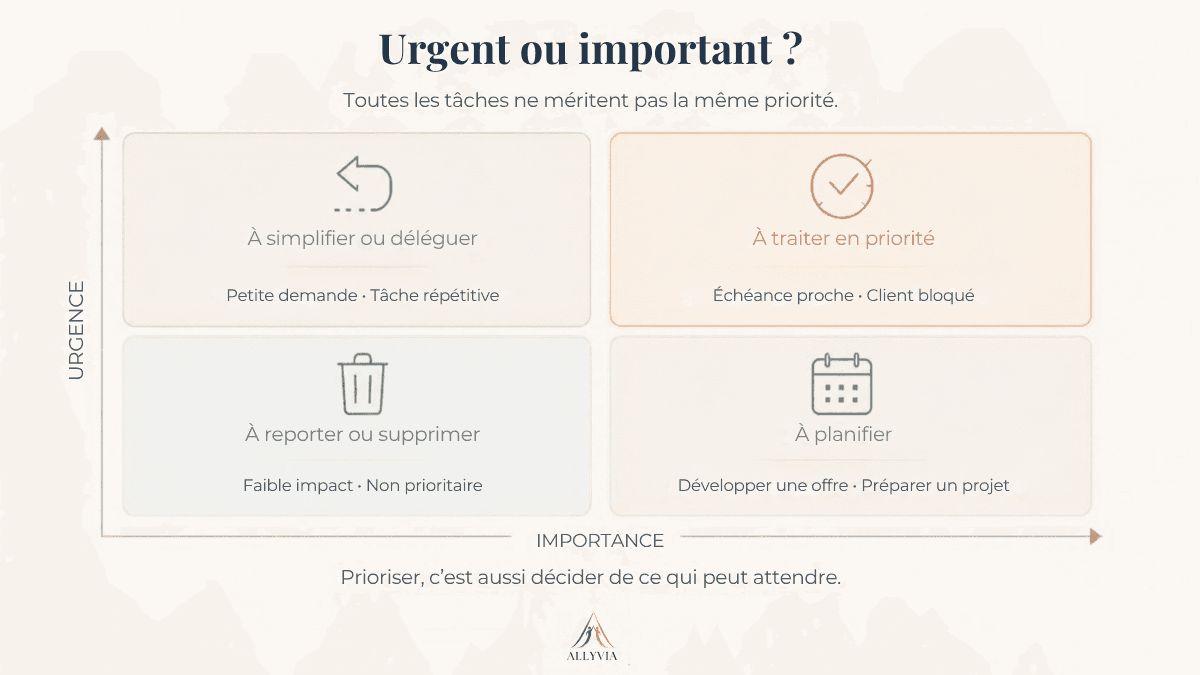
You can then sort your tasks into four categories:
- Urgent and important → deal with first;
- Important but not urgent → schedule;
- Urgent but not very important → simplify, delegate or deal with quickly where possible;
- Neither urgent nor important → postpone or delete.
This distinction helps you break the reflex of automatically dealing with the latest request to arrive.
3. Limit your real priorities
A list of twelve priorities is no longer really a list of priorities.
Once your tasks are sorted, choose 1 to 3 main priorities for the day.
These are the things that must move forward even if other requests come up.
You can keep a secondary list for everything else, but it should not constantly compete with your main priorities.
ALLYVIA tip: every morning, simply complete this sentence:
“If only three things move forward today, which should they be?”
This rule forces you to make choices rather than trying to deal with everything at once.
4. Don’t confuse an immediate request with a real emergency
An e-mail has just arrived.
A client asks you a question.
A notification pops up.
This easily creates a sense of urgency, but a recent request is not automatically a priority.
Before interrupting what you are doing, check:
- is there a real deadline?
- is someone held up waiting for your reply?
- is there a concrete consequence if you reply later?
- does this request really need to be handled by you?
A few seconds of stepping back can stop a whole day from falling apart.
5. Group small tasks together
Some tasks are quick, but as they multiply they fragment your attention.
Replying to an e-mail, sending a document, checking a piece of information, making a small update…
Rather than dealing with them as soon as they appear, group them into one or two dedicated time slots.
For example:
11:30 → e-mails and small requests
16:00 → administrative follow-up and replies
This way you reduce interruptions and better protect your periods of focused work.
ALLYVIA tip: turning off certain notifications during your periods of focus can be more effective than constantly trying to resist their pull.
6. Turn vague tasks into next actions
Some tasks stay on a list for a long time because they are too vague.
For example:
“Redo my communication”
does not clearly say what needs to be done.
Turn it into a concrete action:
“List the three content themes for the month”
Same principle with:
“Organise my documents”
→ “Create the folders Clients / Administrative / Communication”
or:
“Get my website ready”
→ “Reread the Services page and note the corrections”
The more precise a task is, the easier it is to get started.
7. Use a simple sorting method
When your list becomes hard to manage again, use this sequence:
Collect → Sort → Prioritise → Plan → Act
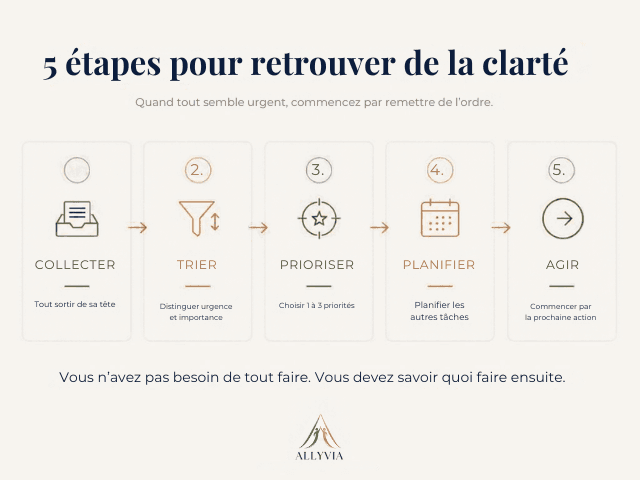
You can use this method at the start of the week, every morning or simply whenever you feel your organisation is becoming hard to keep under control.
The aim is not to finish everything
Regaining clarity does not mean managing to empty your to-do list completely.
In any professional activity, new requests will keep coming in.
The aim is rather to know:
- what needs to be done now;
- what can wait;
- what needs to be scheduled;
- what can be simplified or dropped.
You thus move from an organisation dictated by incoming demands to one guided more by your priorities.
When everything seems urgent, start by choosing
If your day already feels overloaded, don’t immediately try to do even more.
Take a few minutes to put everything down, identify the real consequences, select your priorities and define the next action.
Clarity does not come from a shorter list. It comes from being able to tell what deserves your attention right now.
Need to regain clarity in your organisation?
Have tasks, tools or methods piled up to the point where you no longer know where to start?
The ALLYVIA Clarity Diagnostic lets you take stock of your current organisation, identify the main sticking points and define your priorities.
Aim: to come away with a clear view of the actions to take and their order of priority.
→ Discover the Clarity Diagnostic https://allyvia.eu/services